How to Frame Custom Canvas Prints for Small Living Rooms · Lily & Hendrix

Table of Contents
- What You'll Need Before You Start
- Step 1: Measure Your Wall and Choose a Canvas Size That Fits
- Step 2: Pick a Floating Frame or a Tray Style Frame
- Step 3: Mount Your Canvas Without Damaging the Wall
- Step 4: Hang at Eye Level and Get the Hanging Height Right
- How to Arrange Wall Art in Small Living Rooms
- Choosing a Custom Pet Portrait From Photo for a Small Space
- Step 5: Light It Well and Keep Tonal Consistency
- Frequently Asked Questions
Last Updated: September 17, 2026
What You'll Need Before You Start
Knowing how to frame custom canvas prints for small living rooms is less about the frame and more about restraint. A compact room rewards one well-placed piece over five competing ones.
At Be Artistic Club, we've watched customers hang their first pet portrait and immediately want six more. Resist that urge, at least at first.
Gather these before you begin:
- A tape measure and a spirit level
- Painter's tape for marking positions
- A pencil
- Wall-safe hooks or a picture hanging kit rated for your canvas weight
- A drill if you're using wall plugs
- Your canvas print
If you're still choosing artwork, our guide to hanging art at home covers the basics of placement.
Step 1: Measure Your Wall and Choose a Canvas Size That Fits
The right canvas size for a small living room covers roughly two-thirds to three-quarters of the wall width above your main furniture. Anything smaller looks lost; anything larger crowds the room.
Matching proportions to a compact room
A common mistake is buying the biggest canvas that fits. In a tight space, a smaller piece with generous wall space around it reads calmer than a large one pressed edge to edge.
Step 2: Pick a Floating Frame or a Tray Style Frame
A floating frame leaves a visible gap between the canvas edge and the frame, so the artwork appears to hover inside it. A tray style frame wraps flush around the canvas, giving a tidier, more contained look.
Floating frames versus traditional frames
Floating frames add depth, which can make a small room feel more considered. Traditional and tray styles sit flatter against the wall, which keeps a compact space from feeling busy.
| Frame type | Look | Best for | Visual weight |
|---|---|---|---|
| Floating frame | Canvas sits inset with a gap | Modern, gallery-style rooms | Medium |
| Tray style frame | Flush, boxed edge | Neat, traditional spaces | Low to medium |
| Unframed canvas wrap | Painted edges, no frame | Minimalist, very small rooms | Low |
Step 3: Mount Your Canvas Without Damaging the Wall
This is the step most guides gloss over, and it's the one that decides whether your bond comes back intact. A framed canvas in a small living room is usually lighter than people expect, but the wall behind it is often the weak point, not the artwork.
Match the hardware to the wall
- Plasterboard (most modern apartments): plain screws pull straight out. Use hollow-wall anchors, the toggle or self-drilling type that spreads load behind the sheet. One anchor per hanging point, minimum.
- Brick or concrete: a masonry bit and a wall plug. Slow speed, no hammer action on the drill if the brick is old, or you'll blow the face.
- Timber studs: the strongest option if you can find one. A stud finder is worth the $20-$40 from a hardware store; knock along the wall if you'd rather not buy one.
- Rendered or heritage walls: treat as brick, but drill a small pilot first to check what's underneath.
Weight bands that actually hold
- Under 2 kg: two adhesive strip hooks, spaced wide. One hook is a gamble, two spreads the load and stops the canvas swinging.
- 2 to 5 kg: hollow-wall anchors, or a two-point system with a taut picture wire between them.
- Over 5 kg: wall plugs into a stud where possible, or heavy-duty toggle anchors rated well above the canvas weight. Check the packet, most list a safe working load, and you want at least double your canvas weight as headroom.
The renter-friendly route
If you can't drill, or don't want to, a picture ledge shelf is the quiet hero of small-space hanging. It sits on two small brackets (or adhesive pads for very light loads), the canvas leans against the wall, and you can swap the artwork whenever you like without a single new hole. In a compact room it also doubles as a place to rest a small ceramic or a candle, which ties the wall into the rest of the space.
Step 4: Hang at Eye Level and Get the Hanging Height Right
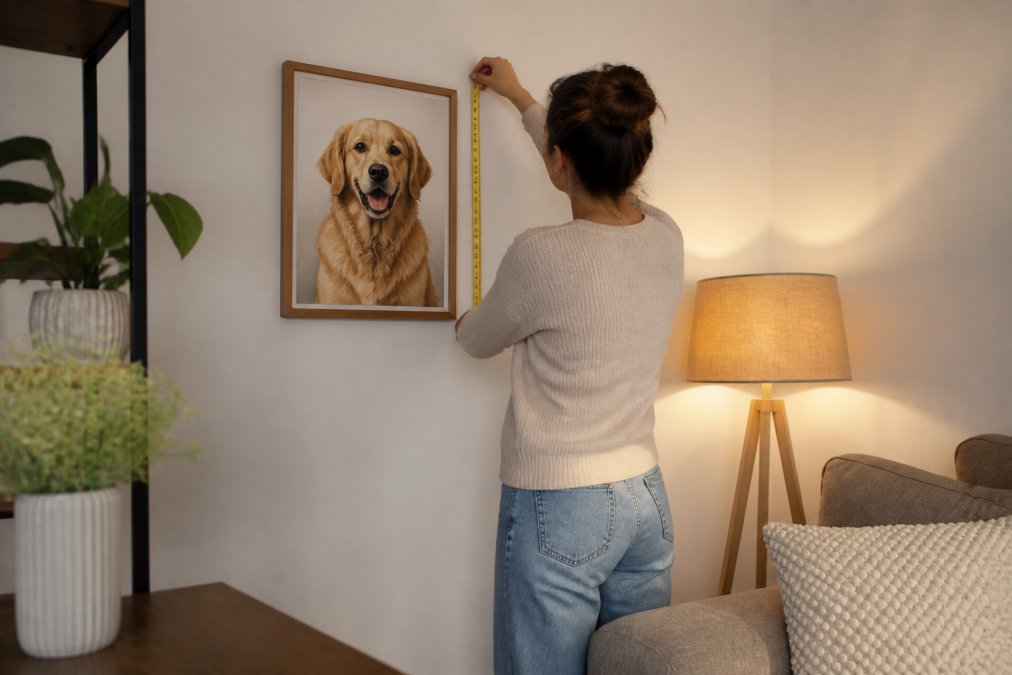
The centre of your artwork should sit at roughly 145 to 150 cm from the floor, which is average eye level for most adults. This single rule fixes more bad hangs than any other.
How to Arrange Wall Art in Small Living Rooms
Arranging wall art in small living rooms comes down to one idea: fewer pieces, more space between them. A single strong canvas usually beats a crowded cluster.
Gallery wall layouts that keep a small room calm
Gallery walls can work in compact rooms, but only with discipline. Pick a tight colour palette, match your frame finish across every piece, and keep 5 to 8 cm between frames.
Choosing a Custom Pet Portrait From Photo for a Small Space
A custom pet portrait from photo works especially well in a compact room because it's personal enough to carry a wall on its own. You don't need a gallery when one piece means something.
- Royal Portrait for a rich, velvet-and-gold look that anchors a reading corner
- Studio Noir for fine-art black and white that keeps a busy room quiet
- The Two of Us if you want you and your dog painted together
- Library Cat for a cosy, bookish nook
Step 5: Light It Well and Keep Tonal Consistency
Here's the thing almost no framing guide tells you: in a small room, light is what makes a framed canvas read as art instead of a dark rectangle on a wall. The frame is only half the job. The other half is what's hitting it.
Why lighting matters more in a small room
A compact living room usually has one window and one overhead light. That's it. The wall opposite the window gets flat, shadowless light all day and nothing at night. A canvas hung there will look dull no matter how good the frame is.
Colour temperature and tonal consistency
Light has a colour, and it changes how your portrait reads. Warm bulbs (around 2700K) make timber, brass and cream tones feel richer. Cool bulbs (around 4000K) suit monochrome and modern interiors but can make warm portraits look slightly yellow or muddy.
- Place a floor lamp to the side, not directly above, to avoid glare
- Angle adjustable picture lights slightly downward and across the surface
- Match your frame finish to your existing hardware: oak with timber, metal with brass or black fittings
- If the room is genuinely dark, a single warm lamp near the canvas does more than three overhead lights
The visual weight trick
One last thing about small rooms: frame thickness changes how big the room feels. A chunky, ornate frame adds visual weight and can make a compact space feel tighter. A slim frame, or no frame at all on a deep canvas wrap, lets the wall breathe. If your room already feels busy, go thinner. If it feels empty, the frame is where you add presence without adding furniture.
Frequently Asked Questions
What is the best way to frame a canvas print for a small room?
A floating frame usually wins in a compact room. It adds a slim border without crowding the artwork, and the visible canvas depth keeps the piece feeling light. Keep the frame finish quiet, such as oak or a thin metal, so the portrait stays the focal point. Hang it at eye level so the canvas sits inside your natural sightline, and leave enough blank wall around it for the room to breathe.
Can I add a floating frame to a custom canvas print?
Yes. Floating frames are built with a small gap between the canvas edge and the frame, so the whole surface stays visible.
Does a framed canvas look better than an unframed one in small spaces?
It depends on the wall. A frame gives a canvas a defined edge, which helps on a busy or textured wall. An unframed canvas wrap looks lighter and more contemporary, and it suits a tight corner where a frame would add visual weight. If you rent and cannot drill, an unframed canvas on a picture ledge or a removable hook is often the simpler choice.
How do I arrange wall art in small living rooms without it feeling cluttered?
Work with one anchor piece and build slowly. A single large custom pet portrait from photo reads calmer than six small frames, and it gives the room one clear focal point. Keep the gaps between frames consistent, usually 5cm to 8cm, and align the tops or centres rather than mixing both. Aesthetic restraint matters more in a small room than filling every blank wall.
Framing art for a tight space is really a lesson in choosing well rather than hanging often. One portrait, hung at the right height, lit from the side, and given room to breathe will do more for a small living room than a wall full of frames. Be Artistic Club makes that single piece easy: upload your photo, see it painted free in about a minute, and let Lily check and adjust it before it's printed and shipped in 3 to 5 days. Choose your style and give your pet the wall they've earned.