How to Choose a Pet Photo for Art: A Simple Guide · Lily & Hendrix

Table of Contents
- Start With the Right Photo and the Rest Follows
- Photo Requirements for Custom Pet Portraits
- Finding the Best Photo for a Pet Portrait in Your Camera Roll
- Pose, Expression and the Details That Make Them Them
- How Pet Portrait Styles Change What Photo You Need
- Pet Portrait Examples: Good Photos vs Tricky Ones
- When the Photo Is Less Than Perfect: Phone Snaps, Old Favourites and Multiple Pets
- Conclusion
- Frequently Asked Questions
Last Updated: October 17, 2026
Start With the Right Photo and the Rest Follows
The best pet photo for art is sharp, evenly lit, and taken at your pet's eye level. Everything else, the style, the size, the frame, follows from that one image.
At Be Artistic Club, we see hundreds of photos every week. The ones that become beautiful portraits almost always share the same handful of qualities. The ones that struggle?
So here's the honest version: a great pet photo for art isn't about having a fancy camera. It's about knowing what to look for.
But first, here's what most guides get wrong. They tell you to use "a good quality photo" and stop there. That's not helpful when you're staring at 4,000 images on your phone.
Photo Requirements for Custom Pet Portraits
Photo requirements for custom pet portraits come down to two things: sharp focus and even light. If both are there, almost any style will work.
The Non-Negotiables: Sharp Focus and Clear Detail
Focus is everything. A portrait can only show what the photo captured. If the fur is a soft blur, the painting will be a soft blur too.
Here's what to check:
- The eyes are crisp. You should see the catchlight, that tiny bright reflection in each eye.
- Fur texture is visible. You can see individual strands, not a smear of colour.
- Markings are clear. That white sock, the patch over one eye, the freckles on the nose.
- No motion blur. A wagging tail is lovely in real life and a nightmare in a portrait.
A common mistake is choosing a photo because it's cute rather than because it's clear. Cute fades. Clarity lasts.
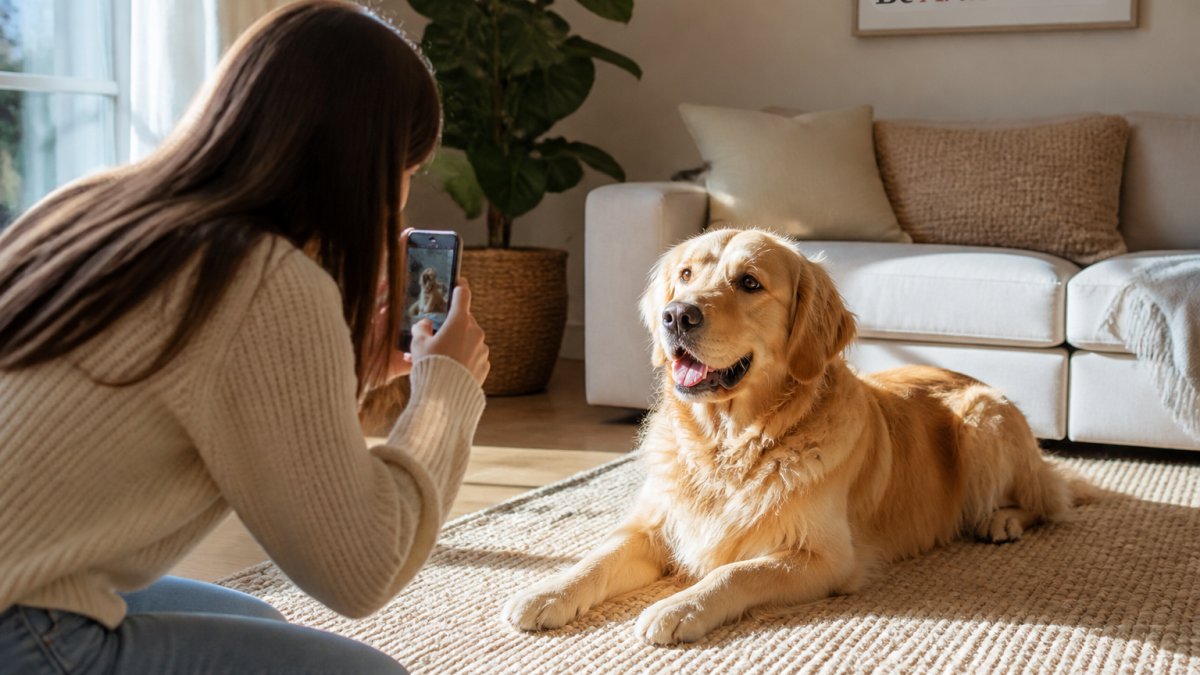
Lighting: Natural and Even Beats Bright and Harsh
Natural lighting is your friend. Even lighting is your best friend. Harsh midday sun creates deep shadows and blown-out highlights, and both are hard to paint faithfully.
Aim for:
- Soft window light, ideally from the side or front
- Overcast daylight outdoors
- No direct flash, which flattens features and creates red-eye
The Australian Institute of Professional Photography notes that soft, diffused light is generally the most flattering for animal subjects. That matches what we see: the photos that translate best are almost always taken in gentle, indirect light.
Finding the Best Photo for a Pet Portrait in Your Camera Roll
The best photo for a pet portrait is usually already on your phone. You just have to know how to find it. Most people scroll past their best shots because they don't look "posed" enough. A tilted head, a mid-yawn, a slightly wonky ear, those are often the ones that translate.
Try this. Search your camera roll for your pet's name or a date you remember. Then run each candidate through the checks below. Not a vibe check. Actual checks.
A Measurable Photo-Quality Checklist
Vague advice like "choose a clear photo" is useless when you're staring at 4,000 images.
1. Focus, zoom in to 100%. Open the photo, pinch to zoom until your pet's face fills the screen. The eyes should still look crisp, not soft.
2. Resolution, check the file size. On most phones, tap the info button (the "i" in a circle) on the photo.
**3.
4. Lighting, look for even tone across the face. Both eyes should be similarly lit.
5. Angle, eye level or slightly above. You want to see both eyes and the shape of the muzzle, not the top of the head.
6. Background, plain beats busy. A cluttered background isn't fatal, but it can make the portrait less focused on your pet.
How to Choose Among Several Candidates
If you have three or four photos that all pass the checklist, don't agonise. Score them. It sounds fussy. It takes two minutes and it stops the endless scrolling.
Give each photo a mark out of 5 on four things:
- Expression, does it look like them? The head tilt, the goofy grin, the judgmental stare.
- Visibility, are both eyes, the full face and the markings clear?
- Pose, is the body angle flattering, or is your pet half-turned away?
- Technical quality, focus, resolution, lighting, background.
Add them up. The highest total is usually the one. If two are tied, pick the one with the better expression, personality beats polish every time.
If you're still torn, send us a few candidates. The free preview shows you how each one translates before you commit. Every portrait is checked and adjusted by Lily, a real person, so you're never relying on an algorithm alone.
Custom Paint by Numbers | Paint your Pet – Personalised Canvas Kit →
Pose, Expression and the Details That Make Them Them
Personality is the whole point. A portrait that captures your dog's goofy head tilt or your cat's judgmental stare is often more meaningful than a technically perfect but lifeless shot.
Look for recognizable traits:
- The way one ear flops
- A signature expression, tongue out, head cocked
- A favourite pose, curled on the couch, sprawled on the tiles
- Distinctive coat markings
Pose matters too. A close-up head shot works beautifully for a formal style like Royal Portrait, where the face and expression carry the whole piece. A full-body shot suits a scene-based style like Storybook Meadow, where posture and setting tell the story.
Framing and composition matter here. Leave a little space around your pet. Avoid cropping so tight that the ears or paws get cut off.
How Pet Portrait Styles Change What Photo You Need
Not every style wants the same photo. This is the part most guides skip, and it's where a little planning pays off.
Different art mediums and styles suit different source images:
- Realistic and oil styles need sharp detail and clear colour. Think Royal Portrait, with its velvet, gold and Renaissance feel.
- Black and white styles like Studio Noir rely on strong contrast and clean lines. A busy background hurts here.
- Watercolour and painterly styles are more forgiving of softness. A slightly imperfect photo can still sing.
- Cartoon and character styles like Head Chef thrive on a clear, expressive face. A funny expression is a bonus, not a problem.
Matching the Medium to Your Photo
Here's a quick way to decide:
| Your photo | Best-suited styles |
|---|---|
| Sharp, formal, even light | Royal Portrait, Studio Noir |
| Soft, warm, slightly imperfect | Watercolour Wash, Golden Hour Walk |
| Funny, expressive, close-up | Head Chef, Private Eye, Sea Captain |
| Multiple pets, clear faces | Double Trouble, Sofa Kingdom |
| You and your pet together | The Two of Us, Best Friends |
If you're unsure, browse all 176 portrait styles and see which one your photo seems to lean toward. And every portrait is checked and adjusted by Lily, a real person, so you're never relying on an algorithm alone.
Pet Portrait Examples: Good Photos vs Tricky Ones
A good photo makes the whole process simple. A tricky one can still work, but it needs a little more care. Here are the patterns we see most.
Good photos usually have:
- A clear, front-facing or three-quarter face
- Soft, even light with visible catchlights in the eyes
- Sharp focus on the face and eyes
- A simple, uncluttered background
- Visible markings and fur texture
Tricky photos often have:
- A blurry face or motion blur
- Harsh shadows or a blown-out background
- Your pet looking away or hidden behind an object
- Heavy filters that change the natural colours
- Screenshots or photos where your pet is very small
None of these are dealbreakers. Our free preview lets you see the result before you order, so there are no surprises.
When the Photo Is Less Than Perfect: Phone Snaps, Old Favourites and Multiple Pets
Old favourites and phone snaps can absolutely become beautiful portraits. We see it all the time. The photo doesn't have to be perfect. It has to be true to your pet.
For phone photos, a few simple fixes help:
- Move closer. Fill the frame with your pet's face.
- Get low. Crouch to eye level.
- Turn off the flash. Use window light instead.
- Tap to focus on the eyes before you shoot.
- Take ten shots. One will be the keeper.
For multiple pets, make sure every face is clear and facing roughly the same direction. Styles like Double Trouble are built for exactly this. If one pet is blurry, sending a second photo of that pet can help us create a clearer portrait.
And if the photo is an old favourite of a pet who's no longer with you, send it anyway. Those are often the most meaningful portraits we make. A soft, older photo can become something tender in a style like Wildflower Crown.
Conclusion
Choosing a pet photo for art isn't about finding the perfect image. It's about finding the one that feels like them. Sharp focus, even light, and a face you'd recognise anywhere will carry you most of the way there.
If you're not sure, send us a few candidates. We'll show you a free preview in about a minute, and Lily will check and adjust the final portrait before anything is printed.
Frequently Asked Questions
Can I use a phone photo for a custom pet portrait?
Yes, and most people do. A recent phone camera takes more than enough detail for a portrait. The things that matter are focus, light and how much of your pet fills the frame. Stand close, tap the screen on their eyes to lock focus, and shoot in soft daylight rather than under a harsh ceiling light. Avoid zooming in digitally, since that softens the image. If the photo looks sharp and clear on your phone, it will work as a pet photo for art.
Should my pet look at the camera in a portrait photo?
It helps, but it isn't essential. A straight-on gaze gives the artist the clearest view of both eyes, which is usually what makes a portrait feel like your pet. That said, a photo where they're looking slightly off to the side can capture their personality just as well, especially for a relaxed or thoughtful style. What matters most is that the eyes are open, in focus and not lost in shadow. Bring a treat or make a familiar noise to get their attention.
What should I do if my pet has dark fur?
Dark coats are the most common photo challenge. Strong contrast hides detail, so photograph them in soft, even light, ideally near a window but out of direct sun. Avoid flash, which flattens the fur and creates shiny hotspots. Turn slightly so the light falls across their face rather than behind them. If you're working from an older photo, send it anyway. A good preview will show whether the markings and fur texture read clearly before you commit.
Can I use a photo with more than one pet?
Yes. Multi-pet portraits work well as long as every face is clear and visible. The tricky part is getting everyone sharp in the same frame, so take a few attempts and accept that one pet may be slightly softer. Avoid photos where one animal is hidden behind another or turned away. If you can't get them together, send separate photos and ask whether they can be combined. Styles like Double Trouble are built for two pets side by side.
Picking the photo is the hard part. The rest is a pleasure. At Be Artistic Club, you upload your photo, see it painted free in about a minute, then choose digital, poster, framed or canvas. Every portrait is checked by a real person, printed in-region by Gelato with 3-5 day delivery, and you can buy two and get the third free. Get started with Be Artistic Club and turn that favourite photo into something worth hanging on the wall.