8 Creative Hobbies for Women Over 40 to Start at Home · Lily & Hendrix

Last Updated: October 25, 2026
Quick Summary
The easiest creative hobbies to start at home are pet portraits from a photo, watercolour sketching, crochet, visible mending, journalling, creative writing, photography and reading. Pick one, not three, and give it a fixed weekly slot. Choose the lowest setup cost and fastest finished result first.
- Pet portraits cost $0 to try, or $69 for a digital portrait, with prints in 3-5 days.
- Journalling works best as a ten-minute daily habit with a notebook costing under $10.
- Watercolour and gouache need $40-$80 for a pad, two brushes and a basic set.
- Crochet is faster to learn than knitting, and a granny square is one evening's project.
- Photography needs nothing extra: natural light, a clean background and getting closer lift any phone photo.
Table of Contents
- Why Creative Hobbies Fit This Stage of Life
- Easy Creative Hobbies to Start at Home
- Journalling for Beginners: Start With Ten Minutes
- Creative Writing Prompts for Adults Who Haven't Written Since School
- Beginner Photography Tips for the Camera You Already Own
- Choose a Creative Hobby That Matches Your Goal
- Upload a Photo and See Your First Portrait Painted Free
- Frequently Asked Questions
Why Creative Hobbies Fit This Stage of Life
Something shifts around 40. The kids need less of you, or the job settles into a rhythm, and suddenly there's an hour in the evening that belongs to nobody.
A creative hobby is any hands-on practice you do for its own sake, not for output. There's real evidence that slow hobbies settle a busy mind before you commit an evening to one.
We're Lily and the team at Be Artistic Club, and we've watched people rediscover this for years. If you haven't made art since school, here's how to start painting as a beginner tonight, low-pressure and without a studio.
Quick picks by goal:
- Want the fastest win: pet portraits from a photo you already have
- Want the cheapest start: journalling, then sketching
- Want something social: crochet, knitting, or a book club
Easy Creative Hobbies to Start at Home
The best easy creative hobbies to start at home need three things: low setup cost, no special room, and a first session you can finish in one sitting. Everything below meets that bar, no talent required, no equipment bought before you know you like it.
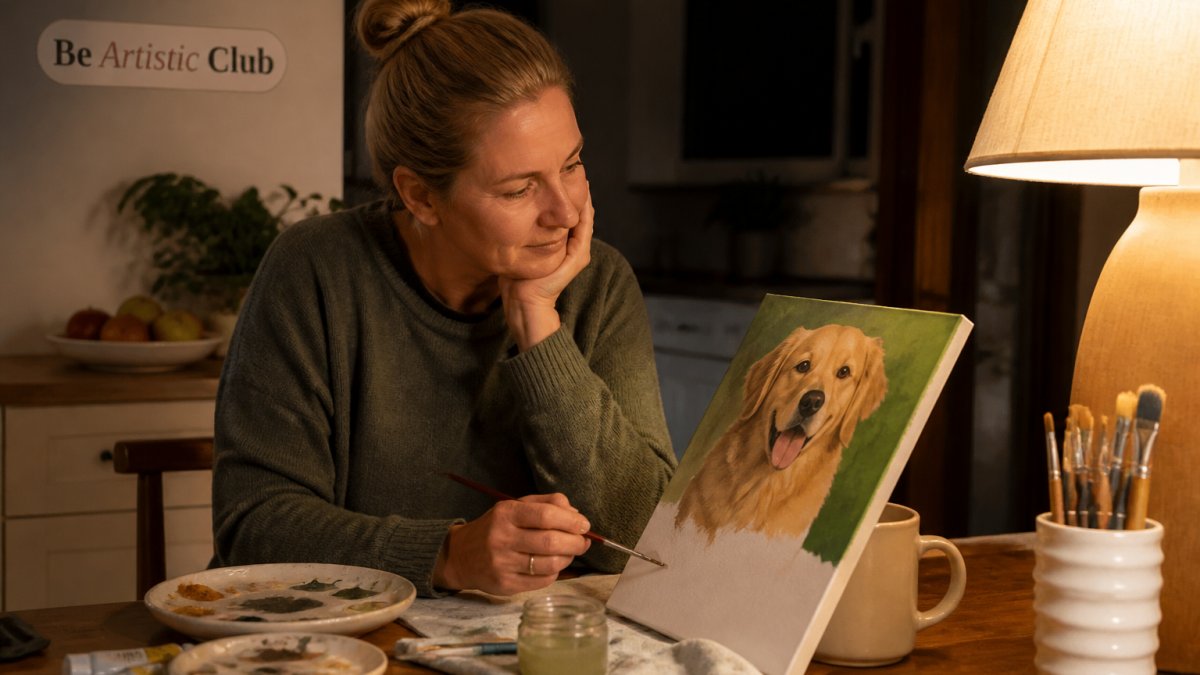
1. Pet Portraits From a Photo You Already Have
This is the one we know best, and the gentlest entry point on the list. No studio, no model. Just a photo on your phone.
Upload a photo, see it painted free in about a minute, then choose your format. Have a look at the full range of portrait styles to compare directions.
Two styles worth knowing: The Two of Us, which paints you and your dog together, and Wildflower Crown, a botanical study that suits a memorial.
2. Watercolour and Gouache Sketching
Gouache is opaque watercolour, and it's the forgiving one. Mistakes dry and get painted over.
Start with one object on the kitchen bench. A mug. A lemon. Your cat, asleep and unwilling to hold a pose. Twenty minutes is a full session.
Watch out: cheap watercolour paper buckles and makes every wash look worse than it is. Buy fewer colours and better paper.
3. Crochet and Knitting for Slow Evenings
Crochet is faster to learn and travels well. One hook, one ball of cotton, and a granny square is a complete project in an evening. Knitting has a steeper first hour, but the repetitive motion is why people keep it, and handmade gifts come out of it, which is half the appeal.
Best for: people who want their hands busy while watching something. Skip if: you get frustrated by counting. Try crochet first.
4. Sewing and Visible Mending
Visible mending is repair as decoration: bold stitching over a worn knee or a small hole, in contrasting thread. It's practical creativity, and it costs almost nothing to try. You need a needle, thread and a garment you were about to throw out. A basic machine helps for hems, but hand-sewing is where most people start.
Watch out: don't practise on something you love. Start on an old shirt.
Journalling for Beginners: Start With Ten Minutes
Journalling for beginners works best as a ten-minute daily habit, not a leather-bound life project. Ten minutes, a pen, and whatever notebook is in the drawer. That's the whole setup, and it costs under $10 if you buy new.
The trick is to remove the pressure of writing something good. Three sentences about the day, a list of what you noticed, all valid. The page doesn't judge.
A first week that actually works
Don't start with a blank page and good intentions. Start with a structure you can drop once the habit holds.
Custom Paint by Numbers | Paint your Pet – Personalised Canvas Kit →
- Day 1: Three sentences about today. Nothing more.
- Day 2: Five things you noticed, a sound, a smell, a colour, a face, a small annoyance.
- Day 3: One thing you'd have done differently, in two lines.
After a week, you'll know whether you're a list person, a sentences person, or a copy-it-out person. Most people are one of the three, and forcing the wrong one is why journalling feels like homework.
The supplies question, answered
You need less than you think. A pen that feels good in your hand matters more than the notebook, a cheap biro you resent is a real reason people stop.
Watch out: don't buy a beautiful hardback for your first attempt. The nicer the notebook, the more you'll hesitate to 'ruin' it. Start ugly. Upgrade once the habit is established.
Why ten minutes is the right number
People who keep a journal for years keep the session short and the slot fixed. Ten minutes is long enough to get past the surface ('busy day, tired') and short enough that you'll do it on a night when you'd rather not. It also fits around other hobbies here, ten minutes of journalling before twenty of sketching is a realistic evening.
Staying with it
- Anchor it to something you already do. After the coffee, before the lamp goes off, while the kettle boils.
- Keep the pen with the book. A journal you have to hunt for is a journal you won't open.
- Miss a day, don't miss two. The habit survives one gap; it rarely survives a week.
Creative Writing Prompts for Adults Who Haven't Written Since School
Creative writing prompts for adults work because they remove the blank page. A prompt gives you a starting line, and starting is the whole difficulty.
Try these:
- Write about a room in your childhood home, using only smells.
- Describe your dog from a stranger's point of view.
- A letter to the version of you who was 25.
Fifteen minutes each. No editing. If a piece keeps pulling at you, that's the one to return to.
Beginner Photography Tips for the Camera You Already Own
Beginner photography tips matter less than most people think, because the phone in your pocket is genuinely capable. Three things lift a photo immediately: natural light, a clean background, and getting closer. If you're weighing a painted portrait against a photo session, we've written a straight comparison of pet portrait versus professional pet photography.
Watch out: digital zoom ruins detail. Move your feet instead.
Choose a Creative Hobby That Matches Your Goal
Match the hobby to what you actually want, not to what looks good on a shelf. The table below is the honest version: start-up cost, time to a finished piece, space needed, and whether you can do it seated.
| Hobby | Realistic start-up cost (AUD) | Time to first finished piece | Space needed | Can you do it seated? | Best for |
|---|---|---|---|---|---|
| Pet portraits from a photo | $0 to try; $69 for a digital portrait, more for poster, framed or canvas | About a minute to see it painted; 3-5 days for a print | None, a phone | Yes | A finished piece on the wall, fast |
| Watercolour and gouache | $40-$80 for a pad, two brushes and a basic set | One 20-minute session | A table | Yes | Learning a skill slowly |
| Crochet and knitting | $15-$40 for a hook or needles and one ball | One evening for a granny square | A chair | Yes | Slow evenings, handmade gifts |
| Sewing and visible mending | Under $20 for needle and thread; $150+ if you add a machine | One evening for a patch | A table | Yes | Practical repair you can wear |
| Journalling | Under $10 for a notebook and pen | Ten minutes | None | Yes | Settling a busy mind |
| Creative writing | Nothing, use the notes app | Fifteen minutes | None | Yes | Self-expression without supplies |
| Photography | Nothing if you use your phone | One walk | Outdoors | Mostly, a bench works | Noticing detail |
| Reading and book clubs | Library card is free; a second-hand copy is a few dollars | One chapter | None | Yes | Connection and conversation |
A few notes on the numbers, because 'low cost' hides a lot. The watercolour figure assumes fewer colours and better paper, cheap paper buckles and makes every wash look worse, so it's a false economy.
Match the hobby to the goal, not the aesthetic
- If you want to relax: journalling, crochet, or watercolour. Repetitive, low-stakes, no deadline.
- If you want to make something you'll keep: pet portraits, visible mending, or a knitted gift.
- If you want company: a book club, a crochet group, or a photography walk.
How to find people doing the same thing
Most hobbies die from isolation, not lack of talent. A few practical routes:
- Your local library runs book clubs and often hosts craft groups; check the noticeboard rather than the website, which is usually out of date.
- Community houses and neighbourhood centres run short, low-cost courses in sewing, sketching and writing, the cheapest way to try a hobby with other people in the room.
- Specialty shops, a yarn shop, an art supply shop, usually know which local groups meet. Ask at the counter.
Upload a Photo and See Your First Portrait Painted Free
The fastest way to test whether a creative hobby suits you is to try the shortest version of it. Ours takes about a minute. Upload a photo of your pet, see it painted free, and decide from there. No account needed to look.
Your pet. Your memory. Your colours. Start with the photo you already love.
Frequently Asked Questions
What are some unique creative hobbies for women in their 40s?
The ones that stick tend to be small, repeatable and tied to something you already care about. A custom pet portrait from a photo you love is a good example: you upload the picture, see it painted free in about a minute, then decide whether to buy. Other options worth trying include visible mending on clothes you already own, gouache sketching, and short-form journalling. The common thread is a low setup cost and a result you can hold, rather than a hobby that needs a whole room before you begin.
Which creative hobbies are genuinely easy to start at home?
Look for hobbies where the first session takes under an hour and the gear fits in a drawer. Journalling needs a notebook and a pen. Crochet needs one hook and a ball of yarn. A pet portrait needs a photo. Photography needs the phone in your pocket. Anything that requires a dedicated bench, ventilation or a class before you can begin is a bigger commitment, and worth saving until you know you enjoy the slower parts of it.
How do I choose a creative hobby that actually suits me?
Start with the goal rather than the craft. If you want to unwind after work, pick something with repetitive hand movement and no deadline, like crochet or journalling. If you want something on your wall, a portrait or a painting gives you a finished object. If you want to think more clearly, creative writing prompts for adults work faster than almost anything else. Then check the practical side: how much space it takes, what it costs to begin, and whether you can leave it out between sessions.
Can creative hobbies help me unwind after a busy day?
They can, and the reason is usually mechanical rather than mystical. Hands-on work occupies the part of your attention that would otherwise keep replaying the day, and a task with a clear next step is easy to sink into. Short sessions work better than long ones: twenty minutes of painting, journalling or photography editing is enough to shift your headspace. Keep the setup out and ready, because the biggest barrier is rarely motivation. It is the fifteen minutes of getting everything out of a cupboard first.
Do I need to be artistic to start a creative hobby at 40 or beyond?
No. Most of the hobbies on this list are about process rather than output, and the ones that produce a finished piece are built so a beginner can finish. A custom pet portrait, for example, is reviewed and adjusted by a real person before it is printed, and a free preview shows you the painting in about a minute so you can judge it before spending anything. The skills people assume are innate, like colour and proportion, are mostly learned by doing the thing badly a few times first.
